
REACT REPLICATION SEMINAR 5
, 09/07/2019 08:07On June 19th, the Internal Replication Seminar 5 “Climate change and other hazards: Impacts and responses in Mekong Delta” was organized at University of Social Sciences and Humanities, Vietnam National University, Ho Chi Minh City (HCMUSSH).
Withing the framework of REACT project, the seminar was organized by Center for Vietnamese and Southeast Asian Studies (CVSEAS). Participants included lecturers, researchers, students and managers from various units in HCMUSSH.

Participants of the seminar
Host speaker of the seminar was Assoc. Prof. Dr. Le Anh Tuan, Vice Director of DRAGON-Mekong Institute, Can Tho University.
.jpg)
Assoc. Prof. Dr. Le Anh Tuan
Delivering the opening remarks, Dr. Tran Dinh Lam, Director of CVSEAS, introduced the goals and objectives of the REACT project as well as the purpose of the seminar.

Dr. Tran Dinh Lam delivered the opening remarks
The seminar revolved around following topics:
- Climate change impacts on the Mekong Delta
- Environmental degradation in the Mekong Delta
- Responses to climate change
Over the past few years, dam development has led to rapid salinization and altered current courses which ultimately results in the decrease of fish and alluvial soil quantity in the region. In addition to natural climate changes, increased use of underground water is the main cause of land collapse.
In response to these problems, Assoc. Prof. Dr. Le Anh Tuan introduced some solutions that farmers are using at the moment including the rice-fish model, rotational rice-shrimp cultivation model… In particular, the rice-shrimp cultivation method exploits mutual benefits of cultivating both shrimp and rice in the same land. During rainy season, farmers grow rice given sufficient fresh water while during dry season, farmers shift to shrimp farming due to water salinization. Decomposed materials from rice will be nutrients for shrimp and wastes from shrimp will be fertilizer for rice.
Lastly, he emphasized the “no-regret” mindset when choosing or proposing solution. By “no-regret”, he reiterated that proposed solutions should be any method that incurs the least mistakes that both we and future generation have to fix.
Some photos of the seminar:
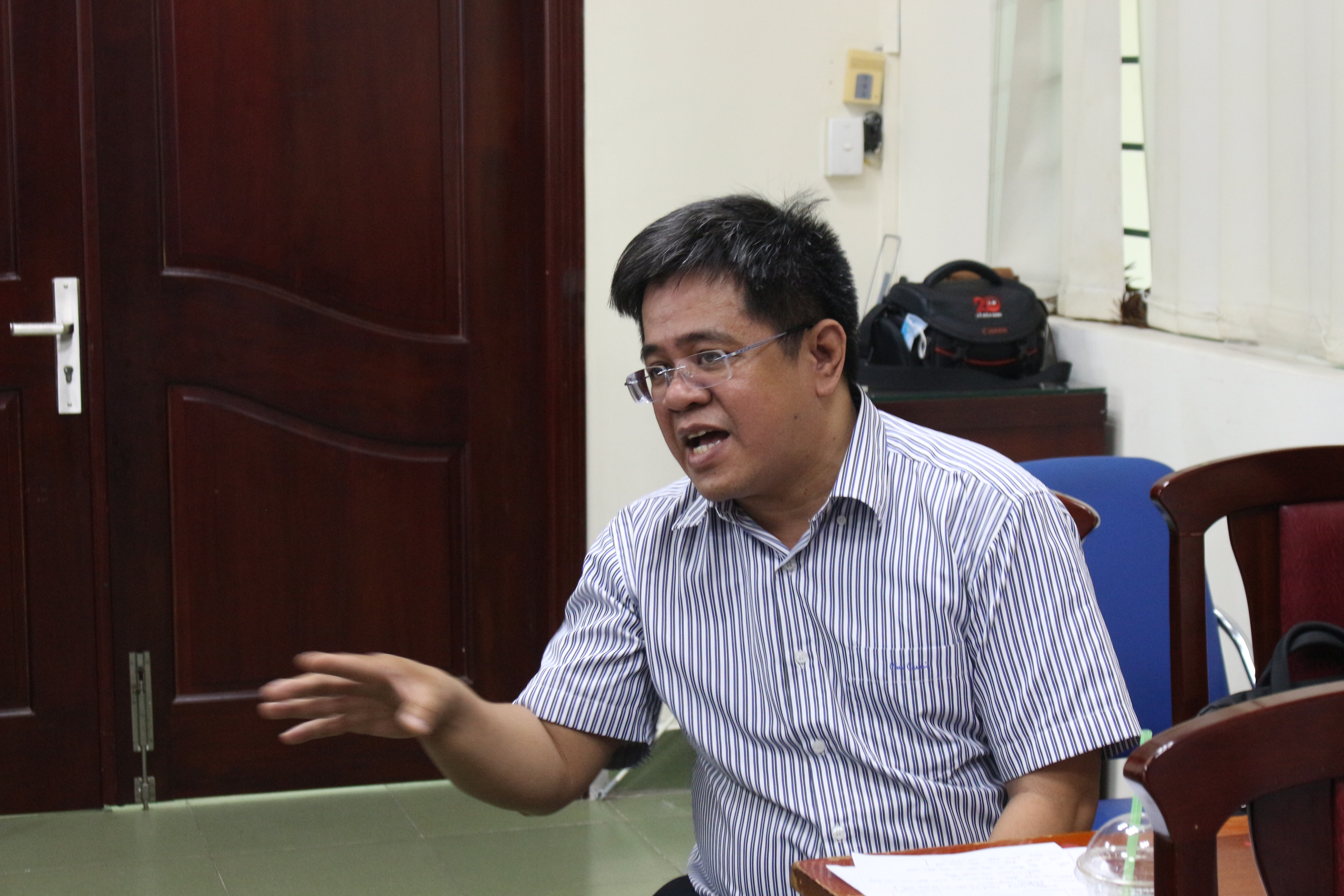
Participant posing question during the dicussion session

Recent news
CHECK AND ACCEPTANCE OF EQUIPMENT FOR PROJECT REACT’S RESEARCHES ON CLIMATE CHANGE